

Funding & Finances
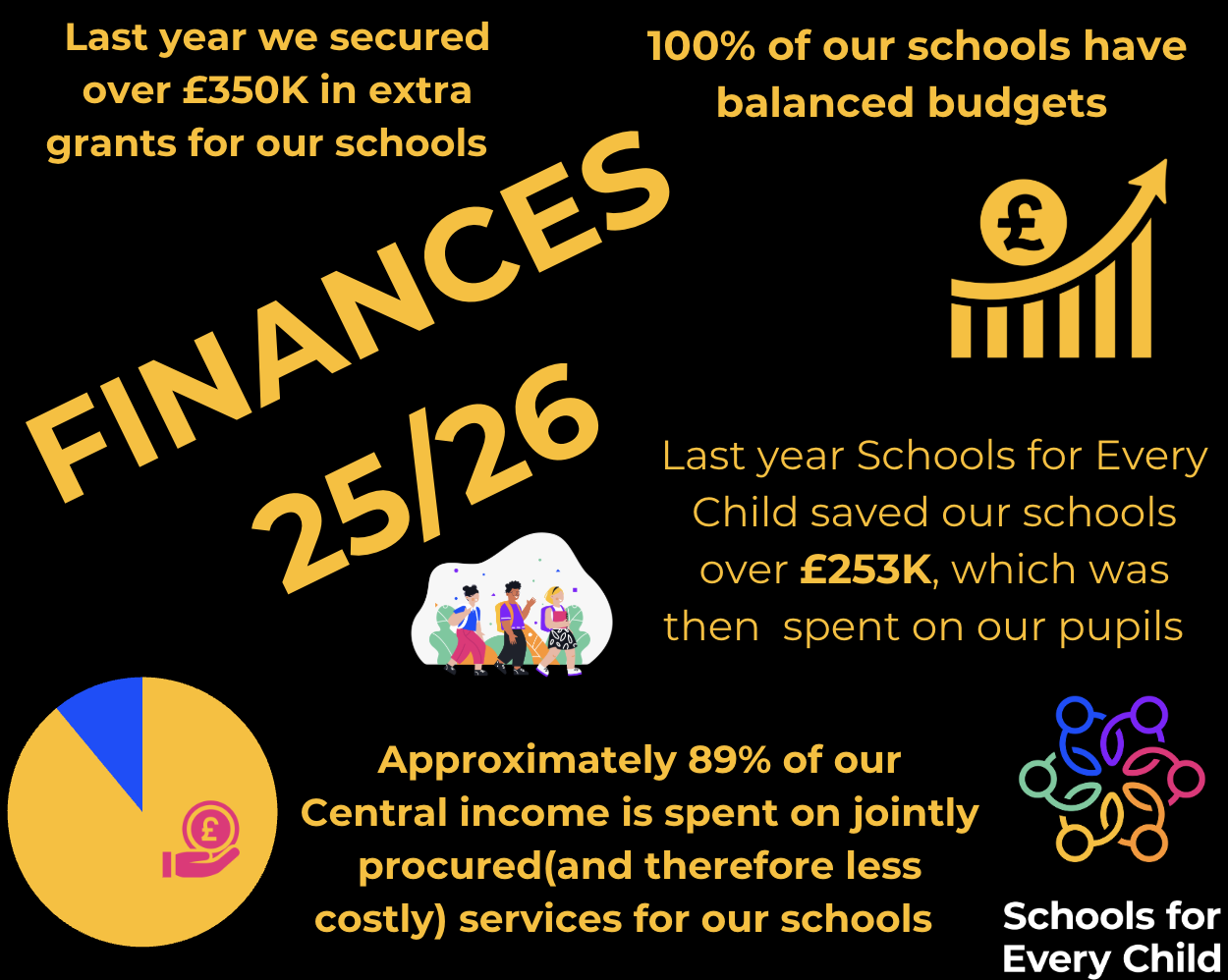
Different Trusts set different ways to pay for services, which reflect how much the centre pays for and how much schools are required to fund themselves. Some trusts take a smaller percentage but then charge for additional services or licences on top of that or require schools to fund certain things, like the MIS system, from their budget. Approximately two-thirds of our schools' contributions are returned to them through jointly procured services, which they would have to purchase at a higher rate if they were not part of our MAT. The rest primarily covers salaries for the central team, who provide daily support to schools and pupils. Not only does this streamline processes, but it also means we can procure things centrally (taking advantage of reduced costs) and keep our approaches unified to share and support each other more efficiently across our schools. The central team and services aim to provide services to schools that they cannot afford alone. The next step will be to look at local services with long waiting lists and provide these for our children centrally (e.g., school nurses, mental health support, Ed Psych support, etc.).
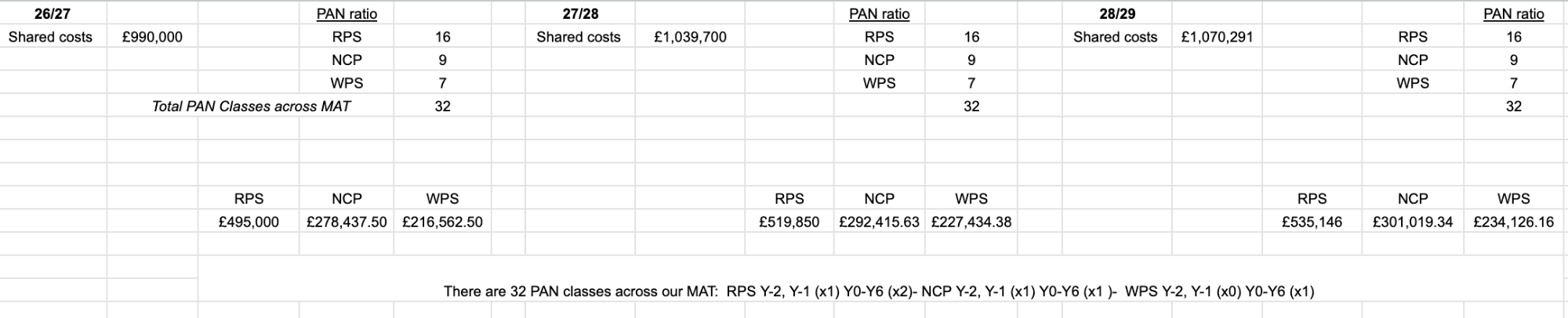
We operate a defined contribution system that ensures financial clarity and fairness for all our schools. Heads and trust leaders collaboratively agree on which services and systems will be centrally funded, and costs are then split proportionally across schools. This approach means that any additional income generated by individual schools remains theirs to invest, while the central trust only requests what it genuinely needs to deliver agreed-upon support and pay for agreed-upon joint costs/ products, rather than taking an arbitrary percentage of school budgets (at present this is around £1000 per pupil). By pooling resources for essential services, we maximise efficiency, reduce costs through collective procurement, and ensure every school benefits from high-quality, centrally coordinated expertise, without compromising their financial autonomy.
Our system has ensured that all our schools all now have balanced budgets, in a climate where schools nationally are often in deficit. Meaning our schools can then spend more money on staffing, pupils and what heads and LSBs decide.
Being part of our trust financially benefits schools because we produce high savings through joint procurement.
A summary of what we currently pay for collectively:
Central team. CEO / Trust DSL / Accounting Officer; Executive Headteacher / Deputy Trust DSL; Central Assistant Headteacher; SEND and Inclusion Lead; COO; CFO; Trust Finance Manager; Compliance Officer; Governance Professional and LSB clerking; Finance Officer; Payroll and Personnel Officer; PA; Fundraising and Marketing Officer; Attendance and Admissions Officer; Facilities / Estate Lead; Mental Health First Aider; apprentice.
The majority of this team's time is spent doing individual processes for schools, which previously were done 3 times at each school, for example, processing invoices or placing orders. This is now done by the HQ team once, aiming to reduce duplication and increase efficiency. So, although they are called the central team, the vast majority of their working week is spent supporting each school. The remainder of their time is spent carrying out the statutory functions required of MATs by the DfE (as outlined in the attached document).
In addition, 5% of all HQ staff time is spent directly supporting learning by hearing readers / running booster groups.
Premises and utilities. Electricity, gas, water and sewage (until Sept 2026); contract cleaning at all three sites; tree surveys and repairs; RAAC annual check; condition surveys; asbestos surveys; fire audits and risk assessments; Essex H&S advisory service and inspections; H&S audit (Judicium); competent person service; keyholding; emergency works fund; PAT testing and calibration.
IT, systems and telephony. Arbor MIS; Access (budgets and finance); Every by Iris (HR, payroll, compliance, risk, H&S and CPD recording); Microsoft licences; Sophos antivirus; iPad management software; signing-in system; Wonde; website and email hosting; managed ICT support; server back-ups; cyber security; Smoothwall filtering and safeguarding monitoring; broadband; VoIP phones and mobiles; photocopiers.
Pupil data and education subscriptions. FFT; Perspective and Nova reporting; Sonar; Accelerated Reader; CPOMS; TeachMate; Evolve and EVC training; CLEAPSS; The Key; GovernorHub; WalkThrus and training; allergy designation.
School improvement. SIP visits and reports (11 visits a year); SATs monitoring and moderation; external education reviews and SDP review; external safeguarding review; HT performance management external support, review meetings and write-ups; Aquinus attendance monitoring; TLRs (including Early Years and SEND).
CPD and training. Two headteacher conferences and one all-staff conference a year; September INSET; annual HQ conference; WELT and CST leadership events; NPQ contributions; supply cover so staff can attend CPD; DSL training; first aid training; safer recruitment and online CPD through Every.
Staff wellbeing. Health Shield for staff and their children (video GP, 24/7 counselling, private fees, stress prevention); qualified coaching for all SLT and DSLs; DSL supervision and support group; counsellor supervision for all heads; counsellor access for staff and after critical incidents such as bereavement; MHFA drop-ins and bookable slots; headteacher sickness insurance.
HR and legal. Juniper HR (named adviser, model letters, contracts portal and templates); employee contracts service; Browne Jacobson legal and HR advice (one account per school); DBS checks; recruitment and job advert sites; union facilities time.
Governance, finance and compliance. External audit (MWS); internal audit (ICE) and finance audit; GDPR audit; website audits; DPO service and ICO fees; NGA membership; admissions and appeals services; pension actuary costs and actuarial report; Essex pensions and MAT fees; Land Registry return fees; banking and bank fees; supply insurance; trust accountant support and SBM toolkit; PEX fees; ERG.
Pupils, parents and communications. Year 6 team-building coaches; Careers Day; CEO Day; pupil Senate trips; pro-social rewards; social media and parent comms; marketing; PLMR crisis comms cover; whole-trust grant bids.
Joint services cost: Approx £500,000 PA.
Central staffing (including on-costs such as pension contributions and NI payments) costs approximately £400,000 a year.
As a Trust, we also procure and pay for the following for all of our schools through group bargaining; these joint services are listed in the attached document.
How funds are distributed across our schools and how much is spent by school in our trust
The remainder of the school's income and GAG stays fully with each school